



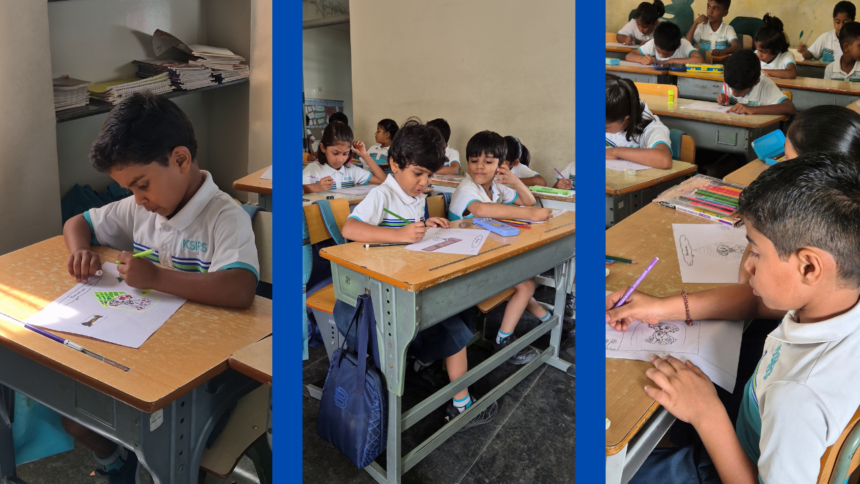
Give a child a pencil and a blank sheet of paper, and something fascinating happens. The page is no longer blank. It becomes a place where a simple line can become a road, a circle can become a face, a few strokes can become a tree, and a collection of seemingly random marks can turn into an entire story. For children, sketching is not simply about drawing. It is about seeing, imagining, experimenting, and expressing.
The joy of making something of their own
There is something wonderfully uncomplicated about giving children the freedom to sketch. There are no complicated instructions. No fixed outcome. No need for every line to be perfect. A pencil moves across paper, and an idea begins to take shape.
A child may start with something familiar and then suddenly add something unexpected. A house might have an unusually large window. A person might have three different colours of hair. A tree might be taller than the building beside it. And that is the beauty of it.
Children aren’t necessarily trying to recreate the world exactly as it looks. They are showing us how they see the world.
Every line is a decision
Look closely at a child sketching and there is far more happening than meets the eye.
- Should the line go this way or that way?
- How big should the object be?
- What belongs in the picture?
- What should come next?
- Should I erase it or work with it?
These small decisions encourage children to observe, think, make choices, and solve little problems independently. Even the occasional mistake becomes part of the process. A line that didn’t turn out as planned does not always mean starting over. Sometimes it becomes something else entirely. A misplaced line becomes a branch, a circle becomes a balloon, a scribble becomes hair and a mistake often becomes an idea.
Sketching without the pressure of perfection
One of the most valuable things about sketching is that it allows children to experiment without needing everything to be “right.” There may be no single correct answer to what a picture should look like. That freedom matters.
When children are not constantly concerned about whether their work looks perfect, they are more willing to try something new, change their minds, and explore possibilities. They learn that creativity is not about getting everything right the first time. It is about trying, observing, changing, and trying again.
A pencil can slow down the world
In a world filled with movement and stimulation, sketching offers children a chance to pause. to look closely and to notice. Maybe the shape of a leaf, how a shadow falls, the expression on someone’s face and details of an object they may have walked past a hundred times.
When children sketch what they see, they begin to notice what they might otherwise overlook. And when they sketch what they imagine, they learn that their ideas are worth giving form to.
More than art
Sketching may begin as an art activity, but its learning extends much further.
It can nurture:
- Observation – noticing shapes, patterns, details, and differences.
- Fine motor control – developing greater control over pencil movements.
- Concentration – staying with an idea long enough to develop it.
- Creative thinking – exploring possibilities rather than looking for one answer.
- Decision-making – choosing what to include, change, or leave out.
- Self-expression – communicating ideas visually when words may not be enough.
- Confidence – discovering that something can be created from one’s own imagination.
The finished sketch is only one part of the experience. The thinking that happens while creating it is where much of the learning lies.
